 DIPMB
DIPMBQuality seal
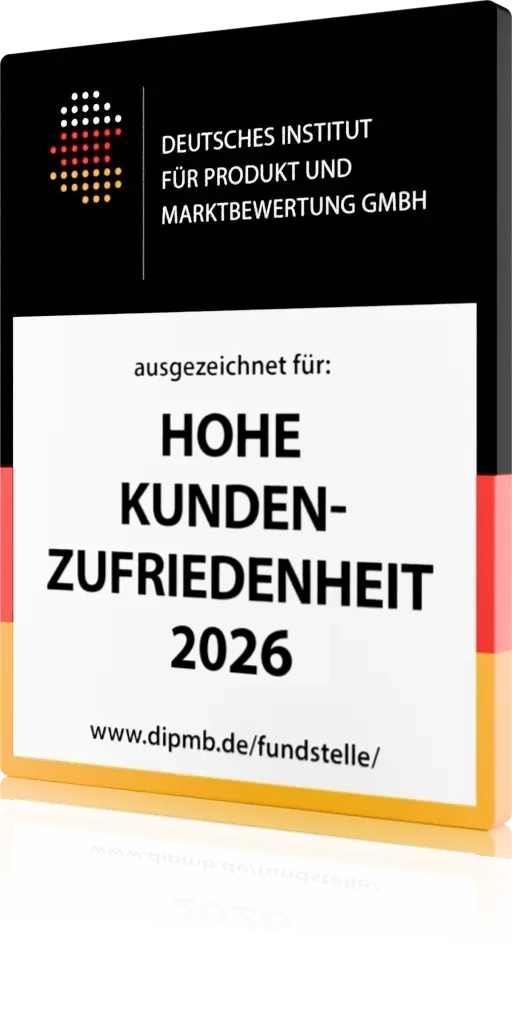
High Customer Satisfaction 2026
You have been recognized!
The German Institute for Product and Market Assessment has awarded you the seal for “High Customer Satisfaction 2026” as part of a Germany-wide study measuring customer satisfaction. This award is strong testimony to your customer focus. It serves not only as recognition of your outstanding performance, but also as a powerful tool for strengthening your market position and convincing your customers.
Please note that you may only advertise with the certification once you have acquired the license rights to the award for 920.00 €. Contact us now, without obligation.
The “High Customer Satisfaction 2026” award makes visible a perception that is reflected in the experiences and feedback of customers. This is exactly where the function of the seal begins.

In markets with a large number of comparable offers, trust, experience and recommendations play a central role in decision-making. External awards can help to make positive customer experiences visible and to set an additional signal of orientation.
The “High Customer Satisfaction 2026” seal indicates that, within the underlying study, your brand stood out through an above-average positive perception on the part of its customers. For consumers, this creates what is known as a social proof effect: when making decisions, people often take their cue from the experiences of others and from publicly visible ratings and recommendations.
Research in consumer studies shows that positive experiences reported by other customers can influence the perception of brands — particularly in situations in which people lack their own experience or offers are difficult to compare.
Companies can use the seal to point to this study result and to make the perceived customer satisfaction around their brand visible, for example on the website, in presentations or in digital communication channels.
Award criteria
The award is based on a data-driven analysis of publicly accessible customer opinions and experience reports in the digital space. The study took the following criteria into account in particular:
1. Customer experiences and reviews
Analysis of whether customers describe their experiences with a brand predominantly positively, neutrally or negatively.
2. Perception of service and customer focus
Assessment of how often aspects such as service quality, availability, reliability or customer friendliness are named in connection with the brand.
3. Consistency of customer satisfaction
Analysis of whether positive customer experiences are recurrently and stably recognizable across different platforms and sources.
4. Thematic context of mentions
Assessment of the topics with which a brand is associated in connection with customer satisfaction, for example advice, support, quality or problem-solving.
5. Public response to customer experiences
Analysis of the general resonance and visibility of customer feedback and reported experience in the digital space compared with other brands within a market.
The method
As part of the study, publicly accessible customer opinions and experience reports from various digital sources were collected and evaluated. The aim of the analysis was to obtain as comprehensive a picture as possible of how satisfied actual customers are with brands and how these experiences are communicated in the digital space.
The data was collected in the period from May 2025 to April 2026 and covered content from the following sources:
Social media
Twitter/X, Facebook, Instagram, TikTok, LinkedIn and YouTube
Review platforms
Trustpilot, Google Reviews, Amazon reviews and Yelp
Blogs and forums
Online blogs, news portals and discussion forums in which consumers share their experiences and opinions
In total, more than 10 million data points were recorded and included in the analysis.
Systematic identification of actual customers
The study focused exclusively on statements by people who could be identified in the respective context as actual customers of a brand. Using AI-supported analysis methods, content was systematically checked for whether it reflected a concrete experience of use, a purchase, the use of a service or a recognizable customer relationship.
Statements taken into account included, for example, those describing the writer's own experience with products, services, delivery processes, advice or the general use of a brand.
Not taken into account, by contrast, were general brand mentions without a recognizable link to experience, purely promotional content, news reports, company posts or other statements without a traceable customer experience.
This deliberate filtering was intended to ensure that only actual customer experiences feed into the study.
Semantic analysis
The customer statements identified were then evaluated semantically using AI-supported methods. This involved not only a classification into positive, neutral or negative tone, but a differentiated analysis of the thematic relationships.
Among the thematic dimensions examined were:
- customer satisfaction
- service quality
- customer focus
- reliability
- product and service quality
- general user experience
In addition to individual key terms, linguistic relationships and semantic fields were also taken into account. This made it possible to include thematically related terms, synonyms and different linguistic contexts in the assessment.
Sentiment and context analysis
As part of the analysis, a sentiment classification was also carried out. This assessed whether customer statements are worded predominantly positively, neutrally or negatively.
In addition to individual terms, the linguistic context was also taken into account, since the meaning of a statement can depend heavily on the setting in which it appears.
Consistency and resonance analysis
In addition, the study examined how consistently positive customer experiences occur across different platforms and what public response these experiences generate.
The combination of systematic customer identification, tone, thematic context, consistency and frequency of positive customer statements allows a data-driven classification of perceived customer satisfaction within the scope of the study.
Result
On the basis of this multi-stage analysis, brands are identified that showed an above-average positive perception by actual customers during the survey period.
Within the scope of the study, these brands can be awarded the “High Customer Satisfaction 2026” seal.
Contact
You can reach us.
For questions about an award, about our methods or about a possible certification.