 DIPMB
DIPMBQuality seal
FMCG 2026
You have been recognized!
Fast-moving consumer goods shape the everyday life of consumers. They include regularly purchased products from areas such as food, beverages, personal care, household and hygiene. The German Institute for Product and Market Assessment examines the public perception of FMCG brands using statistical surveys and AI-supported analysis methods. Brands that achieve particularly positive and consistent results within their respective product category are recognized.
Please note that you may only advertise with the certification once you have acquired the license rights to the award for 2,940.00 €. Contact us now, without obligation.
The German Institute for Product and Market Assessment assesses FMCG brands on the basis of several statistically recorded dimensions of perception. These may include brand awareness, perceived quality, satisfaction, trust, value-for-money perception and willingness to recommend. The specific weighting depends on the subject of the respective study.
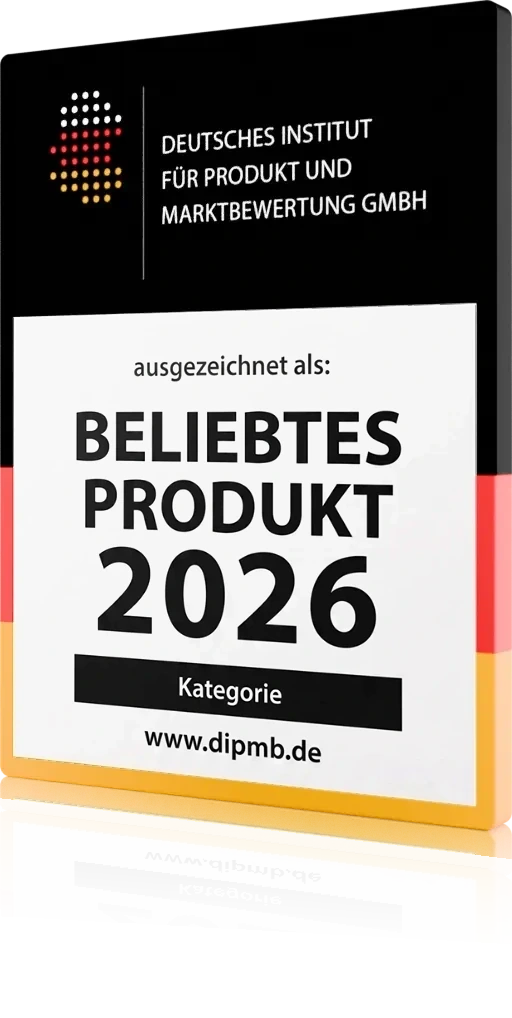
Recognized brands achieve a particularly positive overall result within their comparison category. The award does not constitute a statement about every individual product of the brand; it documents the result of the underlying survey for the survey period stated in each case.
Award criteria
The evaluation is based on various factors. The assessment criteria include, among others:
1. Brand awareness
How well known is the brand within the product category examined? Is it reliably recognized by consumers and clearly associated with particular products, attributes or usage situations?
2. Perceived quality
How is the perceived quality of the brand judged? Among the factors taken into account are the assessment of product performance, reliability and the fulfillment of the expectations associated with the brand.
3. Satisfaction
How satisfied are consumers overall with the products of the brand? The study examines whether experiences are predominantly positive and whether the brand meets the personal requirements of its customers.
4. Value for money
How is the relationship between perceived benefit and the price charged assessed? What matters here is not the lowest price but the subjectively perceived appropriateness of the offer.
5. Trust and loyalty
How high are trust in and attachment to the brand? The analysis examines whether consumers choose the brand again, recommend it or develop a lasting preference for it.
6. Consistency of perception
How consistent is brand perception across different consumer groups, survey dates and assessment dimensions? Individual positive mentions are as a rule not sufficient for an award.
The method
How is the assessment carried out?
The assessment of FMCG brands is based on a multi-stage study model that combines quantitative consumer surveys with structured, AI-supported analysis methods.
As part of the study, product mentions from various publicly accessible online sources were collected and evaluated. The aim of the analysis was to obtain as comprehensive a picture as possible of how products are discussed and perceived in the digital space.
The data was collected in the period from May 2025 to April 2026 and covered mentions from the following sources:
Social media
Twitter/X, Facebook, Instagram, TikTok, LinkedIn and YouTube
Review platforms
Trustpilot, Google Reviews, Amazon reviews and Yelp
Blogs and forums
Online blogs, news portals and discussion forums in which consumers share their experiences and opinions
In total, more than 10 million data points were recorded and included in the analysis. Both direct product mentions and comments, posts and hashtags relating to brands were taken into account.
Semantic analysis
The product mentions collected were evaluated semantically using AI-supported methods. This involved not only a simple classification into positive, negative or neutral tone, but a differentiated analysis of the thematic contexts.
Among the thematic dimensions examined were:
- trust in the products
- customer focus
- performance
- reliability
- general product reputation
In addition to individual key terms, linguistic relationships and semantic fields were also taken into account. This made it possible to include thematically related terms, synonyms and different linguistic contexts in the assessment.
Sentiment and context analysis
As part of the analysis, a sentiment classification was also carried out. This assesses whether a product mention is worded predominantly positively, neutrally or negatively.
In addition to individual terms, the linguistic context was also taken into account, since the meaning of a statement can depend heavily on the setting in which it appears.
Presence analysis
Alongside tone, the frequency of product mentions was also examined. The analysis considers how often brands are discussed in the digital space and to what extent they form part of public conversation.
The combination of tone, thematic context and frequency of mention allows the product perception to be classified within the scope of the study.
Result
On the basis of this multi-stage analysis, products are identified that were mentioned in the digital space with above-average frequency and predominantly positively during the survey period.
Within the scope of the study, these products can be awarded the “Popular Product 2026” seal.
Contact
You can reach us.
For questions about an award, about our methods or about a possible certification.